Saturday, November 4, 2017

Acids and bases- how acidic are they? 11/4/17

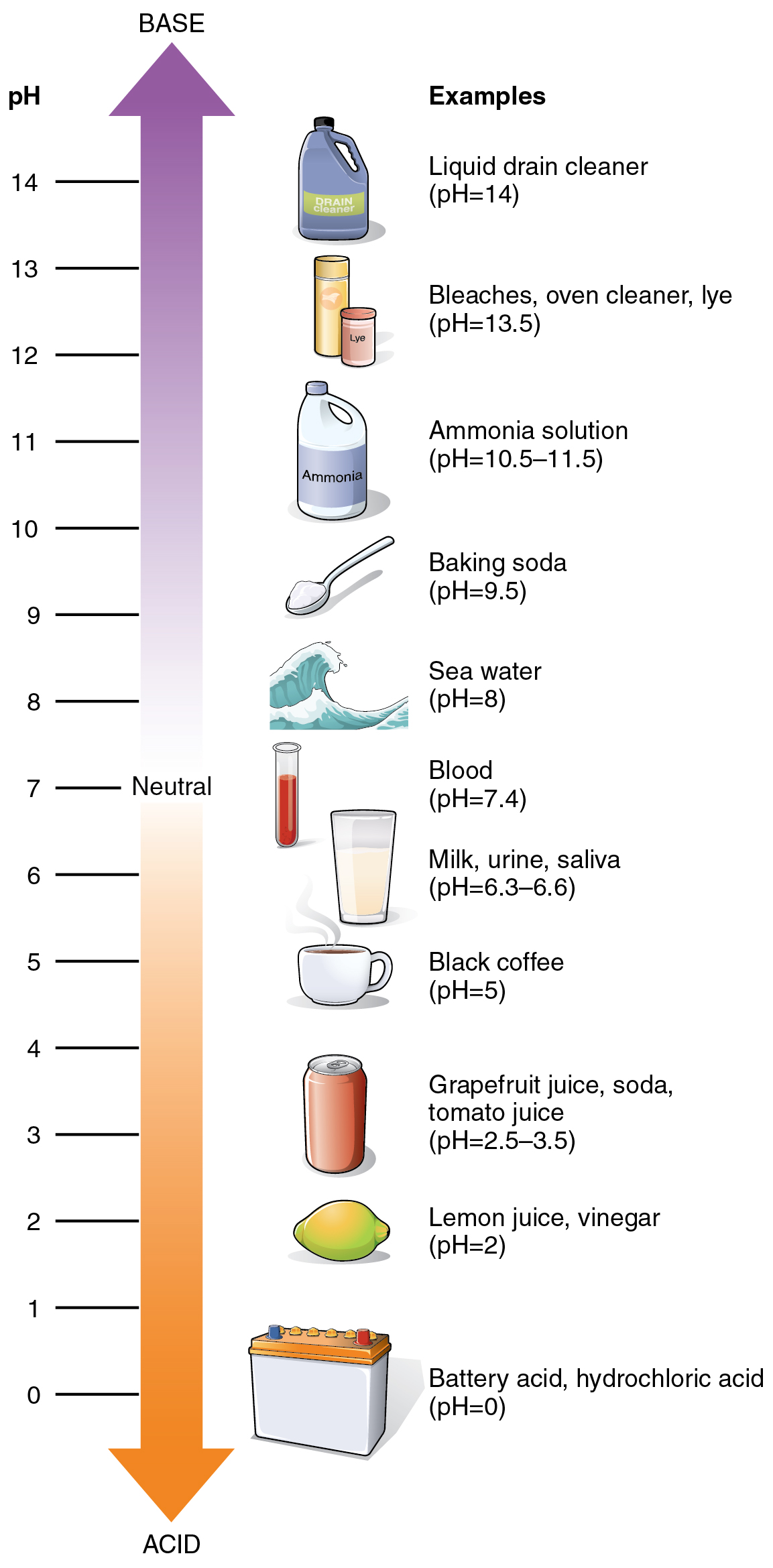
216_pH_Scale-01.jpg


Last week, we learned:
  • What a precipitate is
  • What a catalyst is
  • How to classify chemical reactions
This week, we will learn a bit more about acids and bases. And the pH scale. We learned a lot of these things last year, but we are recapping it.


WHAT THEY ARE-ACIDS AND BASES

Acids and bases are just acids and bases. They are everyday things, and they have a certain acidity-the acids have high acidities depending on what they are, and the bases do too. What about water? Water is acidic?! Why doesn’t it burn me up when I drink it?? Well, water is neither an acid nor a base. We call these substances neutrals. More about that later. We use a little thing called the pH scale to determine how acidic or basic something is. Litmus paper is a thing like that as well, but it only tells you whether the substance is an acid or a base and not how acidic it is.


pH SCALE-WHAT IT IS AND HOW IT’S USED

The pH scale is a way of determining the acidity of something. The numbers go from 1-14. The colors- Oh, well, I’ll show you…

ACIDS-WHAT ARE THEY?

Acids are acidic. That is how we describe them. I know, it may seem obvious, I mean the word acid is literally in the name, but acids are pretty cool. Let’s learn a bit more about them.


On the pH scale, an acid is less than pH 7. In other words, the reds, oranges, and yellows on the scale. The lower the number, the more acidic they are. pH 1 is extremely acidic, about the acidity of hydrochloric acid. pH six is about the acidity of urine or saliva. That’s the yellow. Everything in between… oh, well, later on there will be a more detailed one. On a piece of litmus paper, if you put it in an acid, the paper would turn red. That’s how it is with acids. They turn the paper and the indicator red. Speaking of indicator, we used it in our experiments. Universal indicator shows you if the substance is an acid or a base. For example, you place three drops of indicator in a small bowl. Then you pour three drops of, say, vinegar. We know vinegar is acidic, but let’s pretend you don’t. You watch as the mixture turns a pinkish-orange color. You can test the color against the pH scale to find out how acidic the vinegar was.


BASES-WHAT ARE THEY?

Bases are basic. Same as acids, that is obvious, because the word base is literally in the name. But bases are pretty much the opposite of acids. Let’s look deeper.


To be considered a base, the mixture of universal indicator and your substance has to be dark green, blue, or purple. Let’s say you added ammonia solution. Ammonia is basic, about an 11 on the scale, so the indicator would turn purplish. Same as acids, you can pour them on litmus paper. Same as acids, the paper only tells you i the solution is acidic, basic, or neutral. If the solution was basic, then you would see the litmus paper turn blue. Examples of bases are bleach, soapy water, cleaning supplies,milk of magnesia, baking soda, and sea water. Eggs are also basic. You can look it up anywhere. Substances are either acidic, basic or neutral, so it has to be one of them.


THE PROCESS OF NEUTRALIZATION

First things first, we need to discuss what a neutral substance is before we get into neutralization. A neutral is a substance that is neither acidic nor basic. It is neutral. If acids turn litmus paper red, and bases turn it blue, it doesn’t take a genius to figure out that neutrals don’t change the color. The color of litmus paper is purple. An excellent example of a neutral is water. Pure, healthy water is a neutral. It is not basic, and it is not burn-your-tongue-out acidic either.  


What happens if you mix together an acid and a base? Does it matter the strength of the acid, or the basicness of the base? What happens? Well, whenever you mix together an acid and a base, you will ALWAYS, ALWAYS, ALWAYS, ALWAYS get some type of salt (which is also a neutral. ALWAYS.) and water. ALWAYS. NO MATTER WHAT. Any type of neutralization reaction will always be a double displacement reaction. Remember the types? Here are some examples of neutralization reactions.


Basically, adding an acid and a base makes a neutral. Pretty easy to remember. If you remember the simple facts about acids and bases, you’re good to go. Let’s recap:
  • Acids make litmus paper red; bases make it blue; neutrals make it purple.
  • Acids are less than 7, bases are more than 7, and neutrals are 7 on the pH scale.
  • All neutralization reactions are double displacements (remember Ethan, Grace, Brianna, and William!).
  • Adding an acid and a base makes salt and water.
  • All salts are neutrals.


S&EP: SP4: Analyzing and interpreting data


This week, we were discovering acids and bases while experimenting. We had a page to graph our discoveries and place them in a table. We would add different amounts of substances inside the testing plates and add indicator. We had to discover the reactions, and we had to analyze the data after we collected it.


XCC: Stability and Change

This week, we got to see the colors of the substances change. A lot of things changed about them, the color, sometimes the substance they were. Once, we even had to blow carbon dioxide into the indicator mixture to make it a neutral instead of an acid. That was fun to watch, the colors getting lighter and lighter until they were a light green. It was fun to watch until I got cross eyed-I was the one blowing.

Sunday, October 29, 2017

Chemistry: The Stories


PF-Ingred-color-feature.jpg


BASICS

We have learned:
  • Counting atoms
  • Balancing equations
  • Elements
We will learn:
  • What is a precipitate?
  • What is a catalyst?
  • Classifying chemical reactions


WHAT IS A PRECIPITATE?

A precipitate is basically an undissolved solid in the chemical equation. The precipitate will always be on the product side of the equation because the reactants have all been transformed. There are none that are left to be a precipitate. So the precipitate is ALWAYS on the product side of the equation. Let’s look at some examples.


WHAT IS A CATALYST?

The catalyst helps the reaction go forward. It is not actually part of the reaction, it just helps it along. Actually, the catalyst is there to affect the rate of the reactions. It doesn’t always go forward, sometimes it make the reaction go slower.
Sometimes, the catalyst helps the reaction by making it go a lot faster. Sometimes, though, the reaction is slowed down by the catalyst.

CLASSIFYING CHEMICAL REACTIONS

There are different types of chemical reactions. Not just one, there are multiple. Let’s discover more.
  1. The Synthesis reaction
The synthesis reaction is when 2 become 1
Example: C + O2 = CO2
MgO + H2O = Mg(OH)2
Think of it this way:
  1. The Decomposition reaction
1 becomes 2
CaCO3 = CaO + CO2
  1. The Single Displacement reaction
Where 2 people break apart and 1 joins another
Fe + CuSO4 = FeSO4 + Cu
  1. The Double Displacement reaction
2 people break up and both meet another
NaCl + AgNO3 = NaNO3 + AgCl


S&EP: USING MATHEMATICS
This week we used math to figure out the answers to the equations. We were still balancing them, just that we had to identify which type of reaction they were. I thought that balancing and identifying equations was important for chemistry work. Once you get the hang of it, it really is quite fun!


XCC: STRUCTURE AND FUNCTION
The different reactions really are just different bonds. In the double displacement, one atom pulls itself off from a structure and bonds with another atom{s} to create a different structure. That is cool and really important, since atoms do that all the time in the world around us.

Sunday, October 22, 2017

Chemical reactions and what they're made of

2000px-Fire_tetrahedron.svg.png


Chemical Reactions

A chemical reaction is a reaction between two chemicals that produces a product. Chemical reactions are shown and explained through chemical equations. A chemical equation should be balanced on both sides, according to the Law of Conservation of Matter.  
This means that there should be the exact same number of atoms on both the reactant side of the equation and on the product side of the equation. Let’s explore a little deeper…

How can you tell if a Chemical Reaction happened?

Well, the way you would figure that out is changing. You see chemical reactions everyday of your life! If you are a cook, then you probably know that, but even if you aren’t, you still see them. Do you straighten your hair? Do you dye your hair? Do you breathe? These are all examples of chemical reactions. But the way you can tell if they happened was this:
  • They change color (hair dyeing)
  • They change smell (something burning on the stove)
  • They change temperature (like water in the shower)
  • They change acidity (When you take TUMS)
Basically, if anything changes at all, a chemical reaction has taken place.


Balancing Chemical Equations


Cooking recipes are balanced chemical equations. You have to have each ingredient balanced with the others to have a good taste. Remember, in chemical equations, atoms are ONLY transformed, not created or destroyed. There is a series of steps to help you understand how to balance a chemical equation.
  1. Get an unbalanced chemical equation.
  2. Put boxes around each little chemical formula in the equation. (This is to ensure that you don't'’ change anything inside the boxes)
  3. Have an element inventory. (Have a list of the elements and the numbers on both sides of the arrow, reactants, and products. Keep it close. It will come in handy.)
  4. Write coefficients in front of the boxes. (You can count numbers and do the math and you will find out the right number to place there.)
  5. Count again. (Check the numbers on both sides. They should match. If they don't, then you need the remaining steps.)
  6. Coefficient again.
  7. Count again.
  8. Repeat steps 5-7 until your equation is balanced.
Let's’ look at some examples.


S&EP: SP5: Using Mathematics
We had to use lots of math this week in our projects. With the chemical equations, we had to use math to balance them correctly. If they were not correctly balanced, we had to keep trying until they were. It was hard to do it at first, and there were some pretty tricky equations, but there is the one way to do it, the easiest way.


XCC, Cause and Effect
This week, I noticed that if we did one thing in the chemical equation, it changes another thing in it. You had to change only one part of it to change nearly the whole thing. It was cool, and I think that changing one thing that changes everything else is awesome.

Friday, October 13, 2017

Chemistry 10/13/17

tekucine.png


In science this week, we started talking more about atom behavior and things like that. We discussed pure substances, mixtures, and chemical reactions.


Basics

Review:
  • A pure substance has definite chemical and physical properties.
  • Matter is anything that has mass and takes up space.
  • Compounds are pure substances composed of two or more different elements.
  • Elements are made up of one type of atom and they are pure substances.
  • Water is a pure substance.


Mixtures

Mixtures are two or more pure substances that are not chemically combined. You can physically separate them. Their components have different properties. There are two types of mixtures.


Homogeneous mixtures
Homogeneous mixtures are the same throughout. Examples of them are:
  • Milk
  • Tomato soup
  • Blood
  • Salt water
  • Lemonade
  • Air
You cannot see their separate parts, but you can separate them.


Heterogeneous mixtures
Heterogeneous mixtures are different throughout. The best way to tell the two types apart  is that Heterogeneous mixtures are chunky, and Homogeneous mixtures aren’t. You can see the separate components, so therefore they are easier to separate. Examples are:
  • Pizza
  • Fruit salad
  • Cereal with milk
  • Salad
  • People
People are heterogeneous mixtures. Can’t you take out the eyes, the teeth, each separate component? It would be painful, but you could. You can take olives off of pizza if nobody like olives. You can take the grapes out of the fruit salad. You can see the separate parts, so it is easier to separate them.


We had to determine each item below to see which ones are mixtures, compounds, or elements. Before looking at the answers, why don’t you try and figure them out yourself?


  • Rocks
  • Pure water
  • Copper
  • Aluminum
  • Jelly beans
  • Lemonade
  • Table sugar
  • Silver
  • Diamond
  • Sand
  • Tea
  • Salt
  • Neon
  • Salad


To separate homogeneous mixtures (which are very hard to see the parts) you heat it.


Counting atoms

Each element symbol has no more than two letters, one uppercase, one sometimes lowercase, and no numbers.
Example: NaCl. There are two capital letters, so you know that there are two elements.


Subscripts
Subscripts are the little numbers in the formula. The number tells us how many atoms of the element before the subscript. Like the formula H2O. We know that there are two Hydrogen atoms because of the subscript. If there is no subscript, like in the Oxygen part of the formula, the value of the subscript is 1, not 0.


Coefficients
The coefficient is the big number in front of the whole formula. Don’t mistake that for a subscript. It is something completely different. The coefficient is applied to the entire formula. So if we had 4H2O, the coefficient would be the four at the front of the formula. Multiply the number (4) by EVERY SINGLE SUBSCRIPT IN THE ENTIRE FORMULA. So since there is the 2 after the H, then we multiply 2X4 and we get eight hydrogen atoms. We have four oxygen atoms because we multiply the one by the four.
S&EP: SP5, Using Mathematics
This week, we were given a sheet to do with a bunch of science formulas on it. But we had to use math to solve to equations using what we had learned. It was very fun. We had to do it in one period, but once you got the hang of it, it was very fun. I liked it a lot.


XCC: Patterns
We had to use the patterns to figure out the answers to the problem. We had to label the element, drop down the coefficient, and add the multiplication problem. All you have to do from there was multiply, add the sums, and that is what the answer was. It was basically the same thing over and over, but it was fun.


Friday, October 6, 2017

PROJECT BLOG 10/6/17

IMG_0103.JPG
NO LINK
This week in class, we had to finish our Periodic Table Project. Our finished periodic table of chips is shown above. We have organized it by type of chips and by flavor.the atomic number is like usual, going left to right and increasing going across is our flavors, dill pickle, original, spicy, limon, ranch, cheese, and barbecue. The dill pickle is at the top, being in pringles and lays where the helium and hydrogen would be on a normal periodic table. We have some blank spots where those chips were nonexistent or unavailable to us, but we left those area alone, hoping they would eventually be filled. The key at the top explains around our table, like a tour guide in a busy amusement park.
The atomic number is the normal way, increasing and this is the chip number on our periodic table. The element image is the chip bag (or part of it). The atomic mass is the number of calories in the bag of chips plus the atomic number. We had some difficulty with that, but soon we figured it out.

Backward-looking
What problems did you encounter while you were working on this piece? How did you solve them?
In this piece, we had some problems at the beginning by just figuring out what to do. Andrew posted the chips idea, but Nic didn’t like it. We couldn’t think of anything else, so Brandon started showing us the ways it could be good. Nic finally agreed, and we went on from there. Second, we couldn’t find out what to do about the atomic mass. Nic thought that Ms. Garcia wanted it to be in order, numerical order, and he said that my idea for calories + atomic number wouldn’t work. I went over to Ms. Garcia to ask, and it turned that Nic has misheard her and that we would have a working idea. Overall, we didn’t have any arguments about what to do or how to do it, so that wasn’t a problem for us.

Inward looking
Have you changed any ideas you used to have on this subject?
No. We at first just had these original ideas, but then Nic said that the idea for the atomic mass wouldn’t work, so we were prepared to change the ideas. But when we couldn't find anything else, we talked to Ms. Garcia to find that our ideas were perfectly fine and that we didn’t need to change them. But when we had to cut out the printed chips, some of the bags were too big to fit the squares they were supposed to be in. So we had to cut them down a little.

Outward looking
What grade would you give it? Why?
I would give our work an A- because we met all of the requirements, but our lines and glued items were not as neat as they could have been. I think we deserve an A- since we worked hard, we completed it on time, and we met all of the components, we were just a little messy.

Forward looking
What would you change if you had a chance to do this piece over again?

I would maybe be a little bit neater with the gluing and the drawing of the lines, but I think that we did a good job and that we have a little bit to improve upon.

Sunday, October 1, 2017

Periodic table 103

Image result for periodic table of stuff


This week we started our project. We tested what we knew about the periodic table’s organization by creating our own periodic table. My group is doing chips. We had to know how to properly organize the chips and how to show periodicity. I will show you what we chose to do and how we know how to do it.


Basics

The periodic table is organized into periods (rows) and families (columns). We had to have six periods and eight families. For our table, the families were the type of chip and the periods were the flavor. We decided on pringles, cheetos, lay's, doritos, ruffles, fritos, tostitos, and sun chips for our families. For the periods, we have original, spicy, limón, ranch, cheese, and bbq. For the top two on the real periodic table, hydrogen and helium, is pickle.

Organization

We are organizing as said above. But this is what it would look like.


Our periodic table is set up like this. The atomic number is like usual, left to right increasing. The atomic mass is the number of calories in the bag plus the atomic number. The element symbol is like this:


S&EP SP2 Developing and using models

This week, we had to draw out or digitally draw the periodic table and insert the images of our chosen topic. My group worked hard to draw the table by hand and we worked together without one single argument.

XCC Patterns

The periodic table is one huge pattern. The atomic number is in order, the elements are arranged in groups to suit them, and they have been grouped with elements of their kind (metal, nonmetal, gas), and they are arranged in order of the mass.

Multiplier


This week I was part creator and part wanderer. I was helping answer my group’s questions and I was adding in newfound information.

Is There Life in Space? 5/23/19

Link  by NASA Solar System Exploration       We all know the typical sci-fi movie where an alien monster drops out of some unknown pl...