Saturday, March 16, 2019

Science of Instruments 3/16


Have you ever wondered how an instrument can make its sound? How people are able to tune them to make whatever sounds they want?

Well, we know that sound is created by vibrations. Instruments cause vibrations, which cause the sounds they make. This may be easy to see in an instrument like a guitar, but may be harder to see on a drum or wind instrument like a clarinet or saxophone.


It’s easier to see on a guitar. The strings vibrate and we get that the sounds bounce around in the body of the guitar. But sound and vibrations work a little bit differently with other instruments.

Instruments can have different pitches based on different things. On a guitar, the strings can be tighter or looser than the others, which can impact how they sound. Saxophones have different holes that can be covered, which stops the amount of air that can escape from the body of the instrument. Drums only really have one sound, but different drums can have different sounds, and when you put them together, they can sound very different.


S&EP: SP2 Models

This week, I used a model of a guitar to explore how different sounds were made. The strings on the guitar were rubber bands, and there were two pencils underneath them. Moving the pencils changed the pitch of the rubber band. Some of the bands were larger, and were looser on the instrument than the smaller ones.

Using this guitar as a model helped me because I was able to see how sounds change when you changed things on the instrument. Moving the pencils changed the pitch, and strumming on them harder made them louder. This model was helpful in teaching me how sounds can change and how sounds can start in different instruments, which I never thought about before.


XCC: Cause and Effect

The instrument I play in the band is the clarinet, which also needs a reed to be played. The reed is very important because the instrument can’t be played without it. It needs to be moist, because if you put a dry reed on the mouthpiece and try to play, it won’t be able to vibrate as much as the wet reed, and you won’t be able to play with it. If the gets chipped, it becomes more difficult to make a sound because there isn’t as much vibration.

If the reed isn’t moist, it affects the instrument’s ability to play. If it’s chipped, it affects the amount of vibration that occurs when the instrument is played. I thought this was interesting because I had never thought of the science behind it. I knew that if your reed wasn’t wet enough or if it was chipped, you wouldn’t be able to play, but I hadn’t thought about the scientific view behind it, and I thought it was interesting.

Sunday, March 10, 2019

Fundamentals of waves in sound 3/10

Fundamentals of Waves

Many things travel in waves: light, sound, water, radio signals. How do waves work? How do they carry all of these things around the universe so quickly? When you think about it, light comes from your lightbulb as soon as you turn it on. As soon as the fire alarm starts, you can hear it. How can the voices of the singers at the opera be so high, while the trombone in the orchestra is so low?


There are two types of waves: mechanical and electromagnetic. Mechanical waves need medium (matter) to travel through, like a solid, liquid or gas. Sound is a mechanical wave. Electromagnetic waves can travel through vacuum (empty space) and don’t need medium to travel. Light is an electromagnetic wave.

When the frequency increases, the pitch does, too. So when you hear a singer holding out an extremely high note, both the pitch and frequency of their sound waves are high as well. Sound is produced when an object vibrates, so when you talk, your vocal cords vibrate to make the sound of your voice.

Sound can travel faster through denser objects.
  • It goes 346 m/s in warm air
  • It goes 500 m/s in aluminum
  • And it goes 3,240 m/s in gold


In solids, sound can travel faster because the molecules are close to each other. In liquids, some energy is wasted in getting to the closest molecule. In gases, sound travels the slowest because the molecules are speeding all around and are spaced far apart from each other. In vacuum, or no space, there are no molecules to vibrate at all, and sound can’t travel.

S&EP: SP3 Conducting investigations

While experimenting to see what sound can travel through, we did a few labs to help us. We first hit our pencil against the table while we were sitting up, and then we hit it again when we pressed our ear to the table, which helped us determine that the sound it made could travel through solids. Next, we put it in a tub of water and saw that we could still hear it, even though it was in the water. Ad if we held it up in the air and did it, we could still hear it. This experiment helped us see that sound can travel through solids (the table), liquids (the water) and gases (the air around us).


XCC: Cause and Effect

Sound is created by a vibration. When you talk, your vocal cords vibrate and make the sound of your voice. This is a cause and effect relationship. Your vocal cords vibrate, causing your voice to talk as an effect. It can happen with any sound - the sound of a tuning fork being hit, the sound of your air conditioner turning on and off, the sound of your car wheels on the highway. Whatever the sound is, it began with the vibration of something and ended with being a sound.

Friday, March 1, 2019

What effect can very loud music have on your hearing? 1/3

Link by researchgate.net


One of the things we don't think about when we turn on our music is how it really affects our ears and hearing. We know that if we turn it up too high, it might damage our hearing, but how much? What is really going on in our ear when we hear a sound, and how bad can our hearing get if we turn up the music more and more? If you want to experience what it's like to lose your hearing, check out this hearing simulator to see what different situations and severity of hearing loss are like. 

We may really enjoy listening to the radio as loudly as it can go. Turning up the TV volume when your little siblings start yelling. Putting on the headphones to drown out any background noise while you do your homework. Little do you know how badly loud noises and music can be for your ears. If you've ever experienced ringing in your ears, it might be because you've been exposed to too many loud noises. Your ears have tiny little cells in them - hair cells - that move around when a vibration of a sound comes into your ear. The nerve cells they release tell your brain that you're hearing a sound, and you can hear. When you hear a really loud noise, the tips of your hair cells can actually break off. Sometimes, they can come back in a few days, but sometimes, they can become permanently damaged. 

When sound waves enter your outer ear, they travel into your ear canal to the middle ear. There, they are turned into vibrations that go into the inner ear. The eardrum separates the inner and middle ear and is attached to the hammer, anvil and stirrup, the three smallest and most delicate bones in the body. The sound waves cause the eardrum to vibrate, which moves the bones. The bones assists with moving the sound into the inner ear. The sound then enters the cochlea, which is filled with liquid that waves around when the bones vibrate. The cochlea holds your hair cells, which look like hairs but aren't. The cells move when the vibrations come, and then the nerve signals tells the brain that you're hearing a sound. The brain puts it all together in the end, and you can hear. 

Loud music can really impact your life. Hearing loss is a really important issue, and when we are exposed to loud music and sounds, we have a higher chance of losing our hearing. As you can tell from the simulator, cases can extend from normal hearing to severe hearing loss. If you want your hair cells to break apart and your eardrums to tear, go on blasting your beats. Otherwise, lowering the volume may be a smart idea. 


To check out more of this topic:


See this video on hearing loss and why your ears ring

Check out this hearing simulator to see what it's like in different circumstances. 


Thursday, February 14, 2019

Clown Town - The Clown Coaster 2/14


Image by Liliana Echeverria

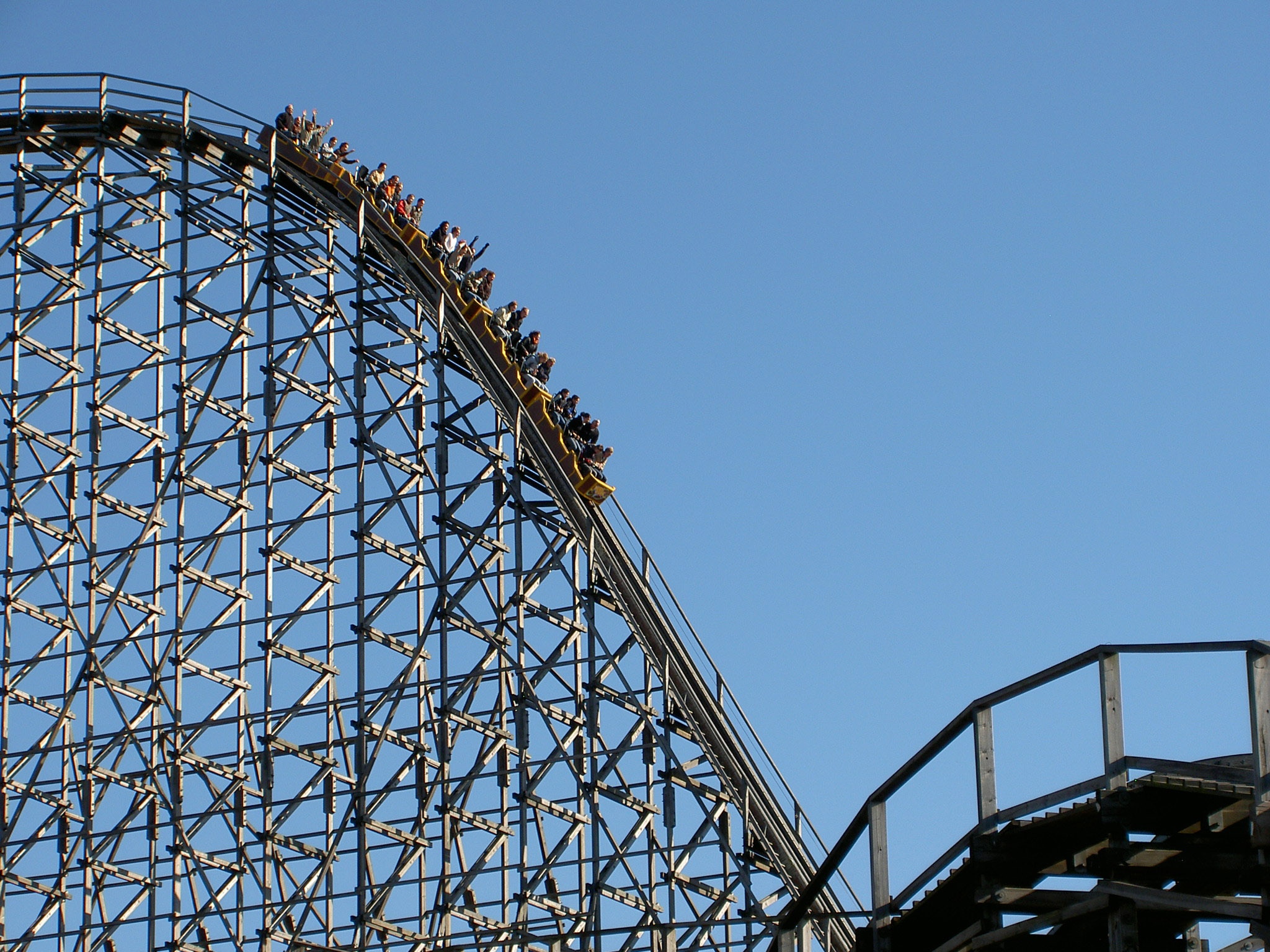
Rollercoasters are very popular amusement park attractions, and for this project, we had to create our own. Using some insulation tubing, straws and tape to make a rollercoaster was difficult, but in the end, we created a coaster with a successful loop, turn and hill. After building the rollercoaster, we needed to use our knowledge of physics to find out the points of highest and lowest kinetic and potential energy and positive and negative acceleration.

The point of highest kinetic energy is where the marble is moving the fastest, which would be that the beginning of the rollercoaster at the drop. The point of lowest kinetic energy is at the very top of the rollercoaster because the marble hasn't been dropped yet. Potential energy would be the highest at the top of the ride before it starts, and it would be the lowest at the drop, where the marble is going the fastest to climb the loop. The acceleration is positive when the marble is travelling down the drop and down the hills. It is negative when the marble is going up the loop and up the hills.


Backward-Looking: What problems did you encounter while working on this piece? How did you solve them?

While we were building our rollercoaster, we had some issues with the marble falling off of the track at the turn. This was because the track was not at the correct angle, and the marble kept bumping against the edge of the support, which caused it to fall off. We troubleshooted this by holding the track in place until the marble was able to make it to the end. Then we used straws to hold the track up. Once the track was perfectly balanced, the marble was able to travel safely to the end.


Inward-Looking: How do you feel about this piece of work? What parts of it do you particularly like? Dislike? Why? What did/do you enjoy about this piece or work?
I am really proud of this rollercoaster. I like that we were able to troubleshoot the track. I enjoyed decorating our rollercoaster and making it look like a real one.


Outward-Looking: If someone else were looking at the piece, what might they learn about who you are?

When people look at this piece ow work, they might learn that I am very creative and I love working with people who can help me get the job done. I like being able to trust people, and our rollercoaster reflects that. I'm a very creative person and that also shines through in the decorations that we put around the ride.


Forward-Looking: What would you change if you had a chance to do this piece over again?
If I could redo this project, I owuld've spent more time on the math and calculations part and making sure that the whole ride was balanced before I actually started decorating. After all of the decorations were on, we had some trouble with the marble falling off of the track, and we had to pay more attention to that.

Friday, February 8, 2019

Rollercoaster 2/8


Using our knowledge of physics, we are in the process of creating a working roller coaster that can carry a marble to the bottom without it falling off. The coaster must have at least one loop and at least one turn.

We needed to construct a working ride, but once it was finished, we needed to calculate different points, like the highest and lowest potential and kinetic energy and two forces that could potentially slow the marble down as it goes along the track.

Potential energy is energy that is not being used. It has the potential to become kinetic. Our roller coaster starts with a drop, so the potential energy is highest at the very top of the ride, which, on ours, is the highest point. This is because the marble hasn’t started moving yet, so it’s waiting to drop. The potential energy is the very lowest at the end of the ride, because the marble is moving quickly and has to be stopped at the end.

Kinetic energy is energy that comes from movement. The highest point of kinetic energy is at the end of the roller coaster, which is the lowest point of the ride. This is because the marble has been moving quickly the whole ride. Because of this, the place of lowest kinetic energy is at the very beginning of the ride, at the top of the drop. Kinetic energy comes from moving objects, and the marble isn’t moving when it’s up there.

Forces that can slow the marble down on the ride are friction and gravity. The marble must not fly off the end of the coaster; we have to slow it down or stop it somehow. Friction is the force that happens when two things rub past each other. When you rub your hands together on a cold day, that’s an example of friction. In this case, we used little pieces of tape and stuck them on the sides of the track. When the marble moved over them, the tape slowed it down. We placed the end of the track at the bottom of a hill, so the marble slows down when it rolls over the hill.


S&EP: Models

Before we began to construct our roller coaster, we had to see how we wanted to design it. We had a base, but the entire coaster had to fit on the base, so we made a paper model of the ride to see how we had to make the turns so that it would fit on the board. Our original idea was the have a one-meter drop with a loop, and then a turn going into a hill, finishing with another loop. We needed to incorporate cost into this, because we needed to ‘buy’ our supplies and we had a budget of $850.00. We didn’t have enough money or space on the board for that amount of track, so we made the drop, loop, turn, hill and another hill. At the bottom of the last hill, we turned the trak slightly to slow the marble down. We needed to use the paper model to see how well the ride would fit on the base.


XCC: Structure and Function

While constructing our ride, we needed to keep in mind the structure and function of our ride. When we tested the marble this morning, it kept falling off the track. We realized that the loop, which had been in perfect condition the day before, was slightly crooked. When we repaired it, the marble went down easily without falling off. The way the track was built affected the marble’s path. While building our final turn, the marble wouldn’t stay on the track because the track was slanted too far. We needed to make sure that the structure of the roller coaster was strong enough and in good condition, because the function of it wouldn’t work otherwise.

Sunday, February 3, 2019

Energy 2/3

Let's listen to a song:


As we already know, it takes a force to move a stationary object. When a force moves something a distance, work is done. Work is measured in joules (J). In other words, force * distance = work when force = weight.

Energy is the ability to do work.

Kinetic energy is energy an object has due to motion. Moving objects have kinetic energy because they are moving. Potential energy is energy an object stores up or is not using. It has the potential to become kinetic.

Gravitational potential energy is potential energy due to an object’s position. Elastic potential energy is potential energy due to compression or expansion of an elastic object. Chemical potential energy is potential energy stored within the chemical bonds of an object.

As the song said, energy that is in motion is kinetic, and energy that is being stored or not used is potential. The example of the boulder waiting at the top of the mountain was gravitational potential energy because of its position on the mountain. Stretching the rubber band and holding it was an example of elastic potential energy because of the expansion of the elastic object. The energy that gasoline has stored up is an example of chemical potential energy.

The six general forms of energy are chemical, mechanical, thermal, electrical, light and nuclear.

Chemical energy is, as we already know, potential energy stored in chemicals, like gasoline. Mechanical energy is acquired or released by moving objects, like a thrown baseball or the turning blades of a windmill. Thermal energy is the motion of molecules and results from friction. Rubbing your hands to warm them up on a cold day is thermal energy.

Light energy is electromagnetic energy and different amounts of it to make different colors of light. Microwaves and lamps use light energy. Electrical energy is the moving of electrons. TVs and computers use electrical energy. Nuclear energy is energy stored in the nucleus of an atom.

Each of the six forms of energy can be converted to different forms and back again because energy is neither created nor destroyed.

An example of energy transformations: Thermal energy from boiling water was converted into mechanical energy when it was blown against wind turbine blades. Later, it was converted to electrical energy when the turbine blades spun, and was converted into light energy to light a lamp.

S&EP: SP4: Analyzing and interpreting data

This week, I used a Gizmo to explore roller coaster physics. I could change the height of the track, the weight of the car and the speed of the car to see what combinations would allow the car to break an egg at the end of the track. After changing the track’s height and the car’s weight and speed, I determined that the factors of speed and mass of the car seemed to determine if the car would break the egg. I constructed graphs to see the changes in the final speed after changing the heights of the track. The graphs helped me see the relationship between the heights of the track, the final speed and the height lost.


XCC: Cause and Effect

Changing factors like the speed and weight of the car can cause the car to break the egg or not. If the car was heavier, would it crack or break the egg even if the track wasn’t very high? If a tall track and a lighter were combined, would the egg break? I had to consider these things while doing the exercise because, when building a roller coaster, these factors will be important to think of to successfully be able to build a working coaster.


Friday, January 18, 2019

Forces 1/18

You may have heard the word ‘force’ before. A force isn’t just what Jedis use when they concentrate. It’s much more than that. In physics, a force is simply a push or a pull. Now, Isaac Newton discovered some laws of motion that have to deal with force.

Law Number 1: Objects in motion tend to stay in motion and objects at rest tend to stay at rest unless acted upon by an external force. This means that if something is moving, it will stay moving unless a force stops it.


 Law Number 2: Force = mass x acceleration (the more mass something has, the more force you need to move it). This means that pushing or pulling something light is easier than pushing or pulling something heavy.


Law Number 3: For every action, there is an equal and opposite reaction. Forces can either be balanced or unbalanced. If the force is balanced, then moving objects remain moving with the same speed and direction and unmoving objects remain staying still.


If two forces of 50 N (newtons) were acting upon the same object in different directions, the forces would be balanced. If two forces were acting upon the same object in opposite directions, one 50 N and the other 100 N, the forces would be unbalanced, and the moving object would change speed or direction, and an unmoving object would start to move.

 S&EP: SP2 Using Models 

I used models to understand more about Newton's laws of motion by using this simulator to experience more. The simulator helped me understand Newton's laws better, especially his second law. By placing the heavier items in front of the man, I saw that he had to use lots more force to push it. This simulator helped me understand and see how the laws worked in real life. 

XCC: Cause and Effect 

Newton's laws of motion sort of display a cause and effect relationship. His first law states that moving things stay moving unless a force stops them. The force is the cause and the object stopping is the effect. The second law states that the heavier something is, the more force you need to move it. Something being heavier is the cause and you using more force is the effect. The third law states that every action has an equal and opposite reaction. If you throw a ball, the throw is the cause and it bouncing up again is the effect.

Friday, January 11, 2019

WAC - Are self-driving cars worth the risk? 1/11

lecheverria1005
Ms. Garcia
Science 8
January 8, 2019

Are self-driving cars worth the risk?


     Almost everyone knows the feeling: you’re busy with something when you suddenly have to get up and drive. Taking your son to a soccer game when you were on a business call, having to drop your daughter off at ballet when you were trying to nap, or visiting a relative when you were trying to eat. What if that would stop? What if you were able to get in the car and enjoy a sandwich or a nap without even having to put your hands on the wheel? That so-called fantasy is actually very close to being a reality, but are autonomous vehicles really worth the risk? Technology like this is able to be easily hacked, and sensors on the cars don’t work in intense weather like rain or snow. Furthermore, cars aren’t able to sense pedestrians or read street signs, and in bad weather conditions, they can’t maintain lanes on streets and highways. Of course, having a personal taxi that can drop you off, drive home and pick you back up again is great, but the disadvantages outweigh the good. A self-driving car isn’t worth the risk, no matter how jealous it would make your friends. 

      Autonomous vehicles use advanced technology to be able to drive by themselves, but that doesn’t mean that they can replace human drivers. Cars aren’t able to sense pedestrians or street signs, and they aren’t able to understand things like right of way. Human drivers are able to see the road in front of them instead of simply using a sensor, and the car’s sensors don’t work very well in bad weather. According to the article Are We Ready For Driverless Cars? by Ibrahim Balkhy for NewsHour Extra, “However, the cars are still unable to obey traffic signs, identify pedestrians, or maintain lanes in bad weather on the highway.” Even though the cars are self-driving, they still need a human to make sure they don’t smash into pedestrians and allow other cars their right of way. 

      Even if you can eat a sandwich or nap while making sure your car doesn’t crash, the problems don’t end there. Hacking is another issue that can cause problems for both the car and the driver. No matter how protected the technology supposedly is, you can still be exposed to hacking, which can make your car veer in different directions, no lock properly or cause more serious problems. In the video The Pros and Cons of Autonomous Vehicles, Dr. Billy Abraham says, “However, another one is hacking. Because there is a lot of computers and a lot of cameras and sensors one of the concerns is that people will be able to hack and even route your car to a different direction where you don’t want to go.” (3:53). Hacking could become a big issue in the future of autonomous vehicles, and the cars have lots of technology that could potentially malfunction. Cameras and sensors help the car ‘see’ where it’s going and make sure there are no obstacles that it could crash into, and if they aren’t working properly, the car could crash or get a wrong idea of where it’s going. 

      On the other hand, using autonomous vehicles could reduce the number of accidents and car-related injuries and deaths. In the video The Pros and Cons of Autonomous Vehicles, Dr. Billy Abraham says, “... fewer accidents. If we look at what is happening today, a lot of people are dying on the road because of accidents… and driverless cars are meant to reduce the amount of deaths. For example if only 90% of cars become autonomous, we’ll be able to decrease the amount of accidents by about 80%.” (1:16). Autonomous vehicles use technology to sense their surroundings, and they can make sure that they can keep a safe distance from potential obstacles. Since 2010, multiple companies, including Google, Uber and Toyota. According to Junior Scholastic’s Are Driverless Cars a Good Idea? “Google’s car can figure out if a parking space is large enough, keep a safe distance from other cars on the highway and brake to avoid a collision at city speeds.” Nonetheless, traits like these aren’t enough to fully replace a human driver. Even though the cars are able to keep a safe distance, they aren’t fully able to see if another driver comes swerving up behind them. 

      Although reducing the amount of deaths is wonderful, the cars could actually cause more problems that do good. In fact, the cars could crash more often and more seriously and could potentially end up doing more harm than human-driven cars. Ibrahim Balkhy, the author of the article Are We Ready For Driverless Cars?, says, “One of Google’s cars did crash in August 2011, but the company says that it was being piloted by a human driver at the time.” Even though a human driver was in the car, it doesn’t change the fact that the car was driving itself and crashed while doing so. Balkhy also states, “The question of legal responsibility also remains a sticky issue. If one of these vehicles collides with another, or with a human-driven car, whose insurance pays the claim? If a police officer pulls over a driverless car, who gets the ticket? Whether or not the cars will be able to react to an officer directing them to pull over is not clear. Legal structures for insurance traffic violations will have to be changed to account for driverless cars.” If your car dropped you off at a friend’s house and drove back to yours at a crazy high speed, would it know a policeman was trying to pull it over? If nobody was in the car, who gets the speeding ticket? Legal questions like these are yet to be determined, and they could stop the rise of autonomous vehicles. 

      Accordingly, self-driving cars aren’t safe. Technology is too risky, and their sensors and cameras aren’t accurate enough. Though they mean to reduce the number of crashes, they could end up causing more, especially if they don’t work in bad weather conditions. That means that if you live somewhere where it rains or snows a lot, you can’t even drive your car! Autonomous vehicles require smooth roads with clearly painted lines free of bumps or potholes. Imagine what construction we would have to do to accommodate this higher standard! Furthermore, there’s no way to tell how many deaths self-driving cars will prevent. Sorry, Google. Looks like you still have a long way to go before your cars can start rolling the road. 


Thursday, December 20, 2018

Charity Fair Project Blog 12/20

https://drive.google.com/file/d/1S1_6YWG6rtJ4_6YY2cL5oTjbxMHGDh7t/view


For Charity Fair this year, our group chose the charity The Children's Defense Fund, a charity that helps children in poverty. We launched the project in Social Studies, where we researched our charity and what it does for the issue(s) it tries to solve. The Children's Defense Fund strives to give each child the future they deserve by abolishing child hunger, poverty and lack of education. The founder, Marian Wright Edelman, dedicated her career to helping these children and making the future more hopeful for them. Every child should be able to have the life that they deserve, so our team decided to to make tote bags with the Children's Defense Fund logo on them to raise money for this charity. Once the products were made, we had to make an Ignite Presentation on the topic that we would present on the night of Charity Fair.The presentation had to have meaningful images that supported what we were saying. The link above leads to the pre-timed presentation that my team made. 

Backward-Looking:
  • How much did you know about the subject before we started?
I'm an eighth grader here, so I've been to four Charity Fairs. The concept was the same: make a product and an Ignite and sell on Charity fair night. This year, though, we were selling in the gym for more space. We also needed to make a business card for our 'company' to hand out to people at our booth on Charity Fair. I liked selling in the gym, and I thought that it was nice with the business cards. It had our charity's information on it as well, so if we were already sold out, people could still donate on their own time. 

Inward-Looking:
  • How do you feel about this piece of work? What parts of it do you particularly like? Dislike? Why? What did/do you enjoy about this piece or work?
I'm really proud with what I made on Charity Fair. My group sold out, and our Ignite presentation made it into the finals, so we stand a chance of getting $5,000 donated to our charity. I liked presenting the presentation to everyone the most; I felt that I had worked the most on that, and we did a really good job. I thought that our trifold and booth was also nice. There were a couple of things with the making of the product that I would make neater, but I'm really proud of my work.


Outward-Looking:
  • Did you do your work the way other people did theirs? In what ways did you do it differently? In what ways was your work or process similar?
Everyone had the same assignments, but everyone did theirs a little bit differently. At home, I made the base of our product and the team added final touches at school. Other groups made the whole things at school, and some made it all at home. We also split up the work among two people each and did what we were best at for the trifold. Some people did decoration while others typed and some printed. Other groups just worked on the same thing.

Forward-Looking:
  • What would you change if you had a chance to do this piece over again?
I would make the product a little bit neater in some places, and I would manage my time a little bit better if I could do this over again. The hardest part was time management. We finished everything in time, but I would still manage better. 

Friday, December 14, 2018

Physics 12/14


Speed is a scalar quantity, using a numerical value and units to describe how fast an object is moving. Velocity is a vector quantity, using a numerical value, units and direction to describe how fast an object is moving and in what direction it is moving. Speed could be 75 km/hr, 61 mph, or 3 m/s. Velocity would look like 32 m/s North, 8 ft North, or 6 mph SW. Velocity is important. If someone told you that you had to go 7 meters at 1 m/s to get to the bathroom, you could go in as many directions as you wanted to and you would have a very low chance of ever reaching the bathroom. if someone told you that you had to go 7 meters to the left at 1 m/s, you would be able to find the bathroom right away. To show the relationship between the position of an object and time, we use position v. time graphs. Position v. time graphs show where an object is and the time it took to travel there. On the graph, the horizontal axis is time, and the vertical axis is position. If the line on the graph is horizontal, that means that the object is not moving. If the line is vertical or sloped, the object is moving at a steady speed.


Image by Mariana Garcia-Serrato/GoFormative

The first part of the line shows that the object is moving at a steady speed and that time is passing. The line cannot end halfway through the graph because that means that time has stopped, and that can't actually happen (yet). The horizontal part of the line shows that the object has stopped moving and is stationary. Then the third part of the line is more sloped than the first, meaning that the object has picked up speed and is moving after. 

S&EP: SP4 Analyzing Data

This week, we analyzed data in tables to match different graphs, tables and stories together. Different graphs can have different stories that go with them. For example, the graph above can have a story like this: Jerry started out on his walk to school. His watch fell off of his wrist, and he stopped for a while to look for it. When he found it, he started to run because he was going to be late for school. This story matches the graph, because the object/person started out slowly (walking) and then stopped (looking for the watch), then picked up speed (running because he was late). Using graphs can help find the average speed for different objects. On Friday in class, we built a Hot Wheels course and ran four different cars down it. We measure the distance the cars moved and how long it took them to move that far, and then we calculated their average speeds to see which was fastest. 

XCC: Cause and Effect

In the example of the hot wheels course, cause and effects can matter a lot. When measuring the speed and velocity of the cars and comparing them to see which is the fastest, it's important to keep the course the same. If a green car ran one course, and a black car ran a steeper course, then the experiment wouldn't be fair. Both of the cars need to run the same course for the experiment to be fair. A steeper course could make the car go faster, and a flatter course might let it go slower. Even if both cars were on an unchanged course, an accidental push of one of the cars could let it go faster or move further than it would've on its own. 

Friday, December 7, 2018

Physics 12/7

Motion is just one branch of physics, and there are multiple branches of motion. Scalar and vector quantities can impact things like distance and displacement.

Scalar and vector

Scalar quantities are quantities that are measured by magnitude or some sort of numerical value alone. An example of a scalar quantity is 109 mph. Scalar quantities can be how big, how fast and how quick.

Vector quantities are quantities that are measured by a numerical value and a distance. An example of a vector quantity is 27 km/min NE. direction can be right, left, up, down, north, south, east, west, etc. If there is no direction, it is not a vector quantity.


Reference Points

Reference points can be anything. A tree, a rock, your couch, the bus that just passed your car. Reference points can decide whether you are moving or not.

If the distance between you and your reference point changes, than you are moving. If you were sitting still in your car and the reference point was your seat, you would not be moving. However, if the reference point was a tree in a yard your car passed, than you are moving. Your car passed by the tree, and the distance between the car and the tree is changing, so even though you sit still in your car, you are moving relative to the tree.

Distance and Displacement

Distance is kind of an easy concept to get. You walk two miles south, get in your car and drive 10 miles west. What is your distance from your starting point? Twelve miles. But displacement is a little bit harder to understand.

Distance can be moving straight or turning. You start at your house, walk three blocks, turn left and walk four blocks to get to your friend’s house. Displacement starts at the same origin (beginning) but it travels in a straight line. While distance is a scalar quantity (numerical values only), displacement is a vector quantity, meaning that the displacement is written incorrectly if there is no direction in the answer. Based on the question above, what is your displacement?


If you walked three steps forward, three steps left, three steps back and three steps right, you would end up at your starting point. Your distance would be equal to twelve steps, but your displacement is equal to zero because you moved back to your starting point (origin).


S&EP: SP5 Using Mathematics

I used math (ex: the pythagorean theorem) to calculate distance and displacement while completing the formatives this week. Math is useful in this case because it helps you calculate a faster way to get places. In the google map example, we can see how math is useful to find the distances between places. If you were going around museums and ended up in the place you started at, you displacement would be zero, no matter what your distance.


XCC: Structure and Function

This structure (the model) works very well. It is a visual representation of distance in displacement. While not to scale, it is still useful. The function of this model is based on its structure. If you draw the model wrong, you won’t be able to use it and may end up with an answer that is completely wrong. The mistake could be putting the lines in wrong and saying that the displacement is going in a different direction than it actually is. It could be calculating the displacement incorrectly and ending up with the wrong numerical values. Whatever the case, building the structure of this model correctly directly impacts its function as a tool.

Is There Life in Space? 5/23/19

Link  by NASA Solar System Exploration       We all know the typical sci-fi movie where an alien monster drops out of some unknown pl...